Ladies and gentlemen, Dean Stehle, representatives of Romina EiszeitQuell, dear colleagues, students, and friends of the Institute, dear Dr. Cerrito,
It is a great honour and pleasure for me to introduce the 26th laureate of the Tübingen Prize for Early Prehistory and Quaternary Ecology. Covering more than a quarter of a century now, the prize-winning works record the development of our field in a fascinating way. The procedure seems broadly the same: at excavations we find our sources for further analyses in the form of artefacts, fossils, and sediment. The documentation, however, has been significantly altered and refined. The questions addressed to the finds have become much broader and deeper. New analytical approaches and large-scale data processing have provided answers in the cultural, biological, and ecological realms, which we could only have dreamed about thirty years ago. The big challenge remains to not only produce results, but also integrate them into the chorus of hundreds of snippets of different voices and interpret them to get an idea of the original song of human evolution. With the prize, we have touched African beginnings of lithic technology, paleobotanical evidence from early settlements in Australia, and the human dispersal into the high altitudes of the Andes. We learned about Oldowan and Mesolithic subsistence patterns, Neanderthal morphology as well as technology, early recycling of Paleolithic artefacts, new methodological perspectives in genetic and proteomic analyses and dating. This year’s laureate contributes new approaches to the study of individual life histories and their development in human evolution. Her work is an outstanding example of a strong, original research question and a sequence of progressive steps to answer it. The referees were deeply impressed by her inventiveness and analytical rigor. But before getting into too much detail of the prize-winning work, I would like to express the jury’s high appreciation of all the applicants; the importance of the Tübingen Prize is grounded upon their research. Every year, the jury members look forward to reviewing the submissions, to being inspired by fresh approaches and unknown perspectives about our ancestors. It is a privilege to see such a breadth of bright ideas from young scholars. And it is a pleasure to see many of the awardees, promising young scholars of their time, now holding permanent positions. They have major impact on the development of the field through their research and teaching, as, for example, Prof. Shara Bailey from New York University, prize winner in 2006, who was the advisor of this year’s laureate. Today it is my honour to present to you, on behalf of the jury and our sponsor Romina EiszeitQuell, this year’s winner of the award, Dr. Paola Cerrito.
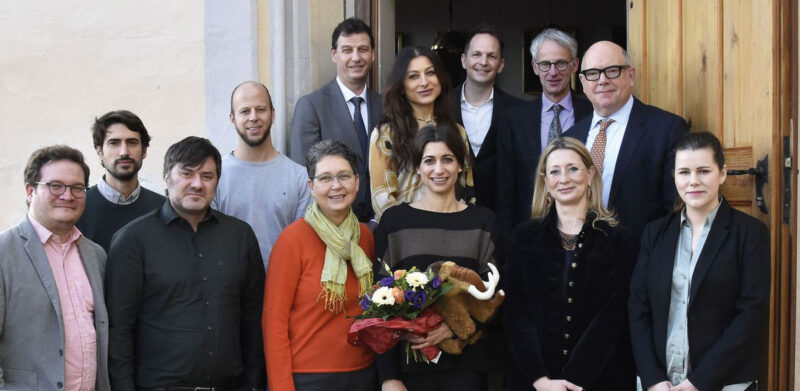
Reihe 1 (von links nach rechts): Prof. Christopher Miller, Dr. Claudio Tennie, Dr. Miriam Haidle, Dr. Paola Cerrito (Preisträgerin), Prof. Katerina Harvati, Corinna Patroi (Romina Mineralbrunnen GmbH). Reihe 2: Prof. Cosimo Posth, Dr. Manuel Will. Reihe 3: Andreas Mayer (Romina Mineralbrunnen GmbH); Mima Batalovic, Daniel Gramer (Marketingleitung, Romina Mineralbrunnen GmbH), Prof. Thilo Stehle, Dean of the Mat.-Nat- Faculty, University of Tübingen; Prof. Nicholas Conard (Photo: Natasha Singh).
Paola Cerrito was born in 1990 in Rome. She began her studies in Biological Anthropology at La Sapienza Università di Roma in 2011 where she earned her B.Sc. in 2014. From 2016 on, she continued her studies at New York University, where she finished her master’s degree in 2020. In parallel, she took up her Ph.D. project on “Histological and elemental markers of physiological stressors in hard tissues”; she defended her doctoral thesis in May 2022. After a stay as visiting researcher at the University of Geneva as well as postdoctoral fellowships at the ETH and the University of Zurich, Dr. Cerrito will take up the position of Assistant Professor at the Department of Evolutionary Anthropology at Duke University in Durham, USA in July 2024.
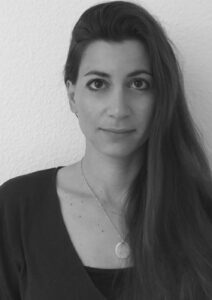
The Tübingen Prize for Early Prehistory and Quaternary Ecology focuses on Dr. Cerrito’s doctoral dissertation entitled “Histological and elemental markers of physiological stressors in hard tissues” supervised by Profs. Shara Bailey, Timothy Bromage, James Higham and Susan Antón. In her work, she investigates how events that influence the metabolism, such as reproduction, menopause and changes in lifestyle, are permanently recorded in the skeleton. This is regarded as the biological archive of a human life. Applied to fossil human remains, new insights can be gained about the life histories of individuals and the development of human traits, such as unusually short birth intervals and an extended post-reproductive lifespan.
Central to Cerrito’s research is the question, how can events of life history be drawn from the skeletal ‘archive’? Her work focuses on events in the life of individuals: At what age did a woman become pregnant for the first time, at what interval did she give birth, how long did she live after menopause? Biocultural changes of such life histories in human evolution represent a second major perspective of her studies. The development of life history variables is traditionally difficult to study: Bones and other mineralized tissues are mainly formed in childhood and adolescence, so that hardly any traces remain of events that happen in adulthood.
Cerrito therefore concentrated on a scarcely researched dental tissue, the root cementum, which anchors the tooth in the jaw. The special thing about this cementum is that it continues to be deposited annually, a bit like tree rings, throughout the life of the individual, starting with the completion of the dental root. Using improved histological preparation and imaging techniques, Dr. Cerrito examined samples from primate and human individuals with known life histories and medical records. She was able to show that events such as menarche, pregnancy, and menopause, but also other physiological stressors associated with significant metabolic changes, leave histological traces in the cementum. Based on the annual deposits, these can be assigned to an age.
Using synchrotron radiation on the ELETTRA SYRMEP beamline in Trieste, Paola Cerrito proved that such histological markers can be detected using virtual histology. As the teeth do not have to be destroyed, even rare fossil human remains can be examined in this way. In a pilot study, she applied these methods for the first time to the teeth of Neanderthal infants and adults from the 130,000-year-old site of Krapina in Croatia and the teeth of early farmers from Serbia. However, the histological markers are non-specific, and it is not possible to distinguish between signs of pregnancy and signs of menopause. Cerrito therefore also investigated the different chemical signatures left on the skeleton by various events in an individual’s life. Her aim is to trace the evolution of the typical human life history with a long childhood and adolescence, short birth-spacing and an increased post-reproductive phase. She wants to understand the interplay of the developmental impulses involved, such as social and reproductive behavior and the need to make optimum use of available food resources.
At the beginning of her PhD project, Paola Cerrito had the wish to reconstruct individual life histories and uncover changes of life history patterns in human evolution. Step by step she approached her objective. She identified an appropriate source to study her issue – root cementum – and proved its suitability. She advanced the field methodologically by optimizing the protocols for histological preparation and imaging. She developed an elaborate non-destructive way to conduct virtual histology to analyse the teeth of fossil humans and showed the potential of this approach with first studies in Neanderthal and Neolithic remains. To differentiate between histologically unspecific markers, she searched for elemental signatures of life history events. Paola Cerrito is broad in her ideas, interdisciplinary in her approaches, sophisticated in the methods she uses, and hungry to discover new territory. Her work opens new perspectives on individual lives of prehistoric women and men, children and elders, as well as on the biocultural development of typically human features in life history. With the Tübingen prize, we honour her efforts to open new windows in our field, but in equal measure, the potential of her approach. Hopefully, it will soon be picked up also by others to bring us fascinating insights into the individual and social lives of our ancestors.
Ladies and gentlemen, I hope that this brief introduction has piqued your interest in Dr. Cerrito’s research and her insights into physical markers of life history events. It is my pleasure to introduce our guest of honour, Dr. Paola Cerrito, who will give us a much more in-depth presentation about her work. On behalf of the jury and our sponsor, the Romina EiszeitQuell, I would like to express our affectionate congratulations and present to you the 26th winner of the Tübingen Prize for Early Prehistory and Quaternary Ecology, Dr. Paola Cerrito!